




















Etching House Buy Sell all Garry Shead artworks, etchings, prints, silkscreens, some pre-owned original paintings, call Rolf at Etching House, Phone 0413007054
Detailed Background information on Garry Shead –
Garry Shead won his first Archibald Prize in 1993.
Garry Shead is a respected and noted Australian painter, print maker, and etcher.
Etching House is proud to collect and deal in his work new or pre–owned.
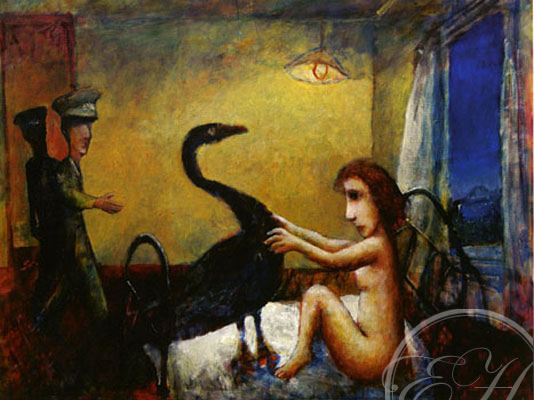
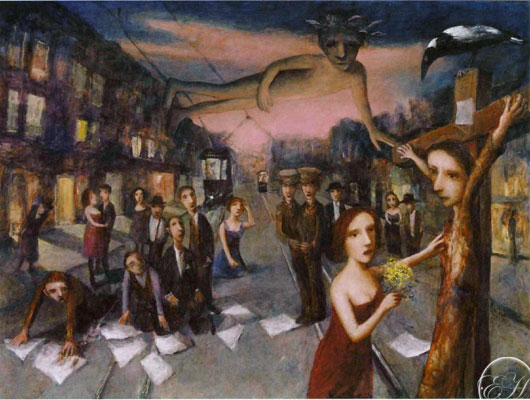
Garry Shead’s works highlight’s a distinctive passion and love for the Australian Landscape as well as a passion for Australian Life and culture, his work also brings romantic and humorous elements to his truly Australian scenes.
Stockman Series – Garry Shead produced the Stockman series from the 1990s this was followed by the famous D.H. Lawrence series based on the Lawrence’s book Garry Shead did a “Kangaroo” and satirical “Monarchy” series of Etchings and Paintings which brought even more attention to this iconic Australian artist are – 1961-62 studied at the National Art School. Editor, the Arty Wild Oat Cartoons published in OZ, The Bulletin, and Sydney Morning Herald.
1963-6 Scenic artist with the ABC TV
1967 Young Contemporaries Prize, Travelled to Japan
1968 Expedition to Sepik Highlands, Papua New Guinea
1972 Artist in residence, Power Studio, Cite des Arts, Paris
1981-82 Artists in residence, Michael Karolyi Foundation, Venice, France. Traveled in, Spain Holland and
1986 Winner, Mahalb Art Prize (New South Wales Law Society)
1987 Finalist, Doug Moran National Portrait Prize
1989-90 traveled to New York, London, and Budapest.
1993 Winner of the Archibald Prize
2004 Winner Dobell Prize for drawing.
Selected Solo Exhibitions
1996 Phillip Bacon Galleries, Brisbane
1996 Lyall Burton Gallery, Melbourne
1995 Greenaway Art Gallery, Adelaide
1995 Solander Gallery, Canberra
1995 Michael Nagy Fine Art, Sydney
1994 Dover Street Gallery, London
1993 Greenaway Art Gallery, Adelaide
1993 Lyall Burton Gallery, Melbourne
1993 Phillip Bacon Gallery, Brisbane
1993 D.H. Lawrence Series, Australian Gallery of New South Wales
1992 Solander Gallery, Canberra
1992 Wollongong City Gallery
1992 Michael Nagy Fine Art, Sydney
1991 Solander Gallery, Canberra
1990 BMG Galleries, Adelaide
1989 Green Hill Galleries, Perth
1988 William Mora galleries, Melbourne
1988 Artnet, Sydney
1987 Solander Gallery, Canberra
1985 Gary Anderson Gallery, Sydney
1984 The Print Source, Sydney
1981-3 Hogarth Galleries, Sydney
1978 Abraxas Gallery, Canberra
1976 Abraxas Gallery, Canberra
1976 Hogarth Gallery, Sydney
1975 Ray Hughes Gallery, Brisbane
1975 Watters Gallery, Sydney
1975 Abraxas Gallery, Canberra
1966-1974 Numerous exhibitions at Watters Gallery, Sydney
Group Exhibitions
Garry Shead has participated in numerous group exhibitions including the Archibald Prize Exhibition, The Blake Prize Exhibition and Sulman Prize Exhibition.
Garry Shead Awards
1986 Winner, Mahlab Art Prize (New South Wales)
1993 Winner Archibald Prize
2004 Winner, Dobell Prize for Drawing
Garry Shead collection held by national galleries
National Gallery of Australia, Canberra
Art Gallery of New South Wales, Sydney
Art Gallery of South Australia, Adelaide
Queensland Art gallery, Brisbane
Lake Macquarie City Art Gallery
Newcastle Regional Art Gallery
Wollongong City Art Gallery
National Museum, Budapest, Hungry
Separation Art Gallery
Visual Arts and Crafts Board, Sydney
State Bank, Sydney
University of Western Australia
University of New South Wales
Australian National University
Queensland University of Technology
Brisbane City Art Collection
Art bank, Sydney
National Film Library
Parliament House Art Collection, Canberra
Garry Shead is a Australian artist who won the Archibald Prize in 1992/93 with a portrait of Tom Thompson, and won the Dobell Prize in 2004 with Colloquy with John Keats (diptych).He went on to win the Young Contemporaries Prize in 1967 and travelled to, Vienna and Budapest. He returned to in the 1980s. His paintings are in many galleries here and overseas. Garry was a friend of Brett Whiteley and participated in the famous Yellow House activities; he also has shown more than seventy group exhibitions and had over fifty solo exhibitions.
Exciting News – Etching House recommends highly not missing this outstanding collection of the beautiful and talented works by Garry Shead, one Australia’s best blue chip Iconic artists.
Details are below –
Garry Shead New Series “Love on Mount Pleasant” “Garry Shead toasts Maurice O’ Shea” Curated by Gavin Wilson, Opened by Her Excellency Marie Bashir AC CVO Governor of New South Wales 9thNovember 2010, and the exhibition may be seen at Australian Galleries Roylston StreetPaddington NSW 2021, the exhibition is current till 27th November 2010.
Titles of the works are as follows –
Garry Shead Australian Oil Painting titles on exhibition till 27th November 2010 are –
The Profundity of wine 2010 oil on linen 71x91cm
The Spill 2009 oil on board 32×32 SOLD Nov 2010
Vigneron and workers 2009 35×39
Vintage Mount Pleasant 2009 oil on linen 127x158cm
Workers drinking wine 2009 oil on linen 46x60cm SOLD Nov 2010
The Pickers 2009 oil on board 32×32 SOLD
The History of Wine 2010 Oil on Linen 92x71cm
Sacramental wine 2010 oil on linen 143x189cm
Reverie 2010 oil on board 42x35cm
Retinue of Dionysus 2010 oil on linen 152×122 Nov 2010
Outside the Church 2009 oil on linen 92×122
“Mount Pleasantania” 2010 oil on linen 152×122
Maurice and Bacchus 2010 oil on linen 62x72cm SOLD Nov 2010
Marriage feast at Pokolbin 2010 oil on linen 92x122cm SOLD Nov 2010
Marriage 2009 oil on linen 71x91cm
Love on Mount Pleasant 2010 oil on linen 122×152
In the Kitchen 2009 79×91 Oil on Linen
Etching House for Australian Garry Shead Fine Art limited edition etchings and quality prints.
Etching House is considered to be the largest retailer of Garry Shead Australian Limited Edition fine art Etching prints and works on paper in Australia.
Australian fine art etchings and limited edition prints have been very successful for Garry Shead as he is one of the best etchers to come out of Australia for a long time, a true master.
Garry Shead has just completed his new etching titled “The Sacrifice” available September 2009 and The Bride of Mount Pleasant available 2010, stock of the new etching titled Sacrifice and the etching titled and The Bride of Mount Pleasant in stock now,
New Etchings from Garry Shead Coming to Etching House July 2010.
Garry Shead November 2010, has 6 new fine art limited edition etchings being released, 3 in colour and 3 in black and white, they are titled “Dionysus at Pokolbin” “The First Vintage” “The First Vintage” Etching House will have these on display at the Sydney Art Fair 11th to 14th November 2010, please stay in touch with Etching House.
Garry Shead draws inspiration from his recent journey to Greece, new innovative work is coming soon.
The following painting and art work’s listed are some of Garry Shead recorded painting sales from 2003 to 2007 by major Auction House’s such as Sotheby’s, Deutscher Menzies, and Christies.
Coming to Etching House, New Etchings by Garry Shead.
The latest record sale was the oil painting titled “Queen of Suburbia” it sold at $432,000 by Sotheby’s Auction house in 2007 setting a new record for Garry Shead art works.
2007 – Queen of Suburbia $432,000
166 x 212 cm,
Oil on canvas, signed and dated 97 lower left; inscribed with title on the back.
2005 – Epiphany 1998
$216,000
16/03/2005
Oil on canvas, signed lower left: Garry Shead, 166 x 212.5 cm,
2003 – Young Prince 136.5 x 182.5 cm,
$204,000
Oil on canvas, signed and dated lower right: Garry Shead 03.
2007 – Coat of Arms 1995
$192,000
19/11/2007
Oil on canvas, signed and dated ‘Garry Shead 95’ lower right, 122 x 153 cm,
2005 – The Novel 1994
$168,000
21/09/2005,
Oil on canvas, signed and dated lower right: Garry Shead/ 94, inscribed on
frame verso: ‘The Novel’ Garry Shead 94, 152.5 x 122 cm,
2006 – The Sentinel $162,000
21/11/2006
Oil on composition board, signed and dated 92 lower right, 90 x 120 cm
2007 – Envoy III (D. H. Lawrence Series) $156,000
13/06/2007
Oil on canvas, signed lower right: Garry Shead, inscribed verso: Envoy III, 92 x 122 cm,
2003 – The Dance 2003$141,000
29/10/2003
92 x 122 cm
Oil on board, signed lower right: Garry Shead, inscribed with title verso:
2005 – The Visitor
$131,450
22/11/2005
Oil on board, signed ‘Garry Shead’ lower right and further signed, dated and
titled ‘Garry Shead/The Visitor 93-94’ on the reverse, 89.9 x 120.5 cm.
Auction Art Sales from 1988 to 2007 inclusive in 000’s of Dollars –
Australian Art – 34,354/1988 – 39,080/1998 – 145,230/2007 with the bulk of the growth being from 2002 to 2007 inclusive.
Indigenous Art – 666/1988 – 5,283/1998 – 23,866/2007.
International Art – 3,454/1988 – 5,758/1998 – 6,534/2007.
Grand Total – 38,474/1988 – 50,120 /111998 – 17,5630/2007.
Trend and price information contained in this Etching House web site segment are from recorded Auction Sales in Australia. The major growth period seems to be 1998 to 2007, with a strong period from 2002 to 2007. The cycle shows 3 years steady growth then one of rest and back to 3 years of growth. The purpose of this information is purely for interest of sake only.
New – Garry Shead art work soon at Etching House.
Garry Shead is working on a new series of Australian paintings, the series relates to his whimsical unique style; Basil Hall is polishing the new etching print plates.
Arrival of the new art series is expected June 2011.
Australian Ceramic Art by Garry Shead soon at Etching House.
Information about the Garry Shead Etching titled Sacrifice is available from Etching House.
Sacrifice was also done as an Oil painting; it is also featured in the book kangaroo by D.H. Lawrence.
Excerpt from Speech by Professor Sasha Grishin AM, FAHA
The Sir William Dobell Professor of Art History – from Etching House
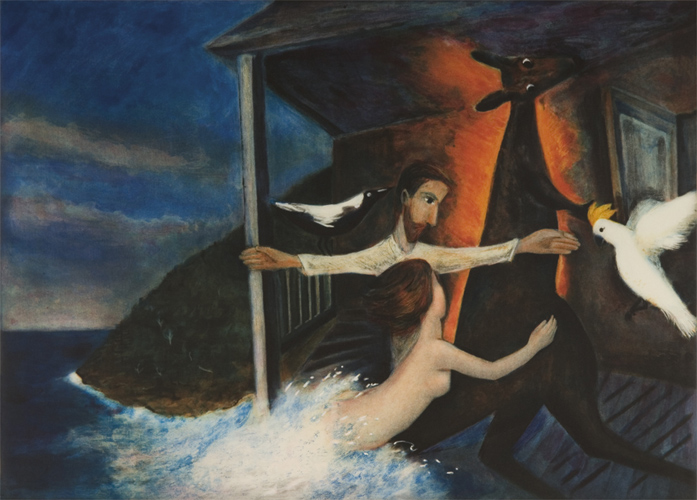
‘The Sacrifice’ Take for example the major canvas, The Sacrifice In the centre are two figures accompanied by the two birds – the magpie and the sulphur-crested cockatoo – and there is thekangaroo in flames in the background which seems to be a source of illumination. All of this, taken together with the coastal cottage and the scrubby foreshore of the NSW coastline, may remind one of the DH Lawrence series, but such a reading would be somewhat erroneous. On closer examination it would appear that the male figure, positioned strategically in the exact centre of the composition, appears as if crucified in space, his head slightly inclined to one side as in traditional medieval Crucifixion of Christ scenes. I think that it was Arthur Boyd who originally introduced the swooping magpie in his Crucifixion imagery of the 1940s. With Shead the magpie and the cockatoo adopt the role of the sun and the moon, the polarity which defines human existence and without which no traditional Crucifixion scene would be complete. The most interesting and telling figure is that of the female nude, who like a mermaid belongs to the sea knowing that if she leaves the water she must perish, while if she returns to the sea she will sacrifice her love for ever. What is very unusual in Shead’s oeuvre is that she has her faced turned away from the spectator and her identity is known only to the one who is crucified. Her form and the colour of her hair suggest that this could be Judit, the artist’s wife who died on 8th of May 2007, yet the work thrives in its sense of ambiguity. When the identities are not firmly fixed, then there is room for allegory and symbolism and the freedom of association which delivers a deeply personal reading uniquely relevant to each beholder. On closer examination it seems that the kangaroo is opening the window and offering a path of escape – but for these sacrificial lovers there is no, and never will be, a way out.
Sacrifice by Garry Shead at Etching House
Etching House specialize in etchings by Garry Shead as well as many other artists producing Australian Limited Edition Fine Art Etchings and works on paper, artists like of Norman Lindsay, Charles Blackman, David Boyd, Olsen, Nolan and Whiteley, from time to time we have a variety of Garry Shead Australian Oil paintings available from the secondary market, these paintings are usually sold by word of mouth before they even come into stock.
Garry Shead is highly acclaimed for his Lyrical paintings in particular the D.H. Lawrence series of 1993, later release’s where -In 1998 he did a series called “Encounters with Royalty” Followed by “The Erotic Muse” in 2001 then -The Ern Malley Series. Garry also did a great series called the “Bundeena Series” along with the famous Annunciation and Epiphany etchings, just to mention a few. His latest series is The God Game and Magus Study, Last Muse, refer to the artists Gallery in the Etching House Web Site. The romance and beauty of Dance was also revealed in the Tango series which saw the release of Tango 1 edition 75, Tango 2 edition 99, Tango 3 edition 99, all sold out quickly. Tango 4 has come and gone, Etching House has only a few of each left in the archive store room.
Garry Shead through his unique talent evident in his oil paintings, original etchings and Limited edition works on paper has earned him a very high level of broad public appeal with great respect and now solid demand for his works with collectors and investors of Australian Fine Art, along with a ever growing following and respect form people of all ages and mean both in Australia and with visitors from overseas.
Garry has participated in many group exhibitions, in particular the Archibald Prize held each year at the Gallery of New South Wales. His work is not a prolific and he has a good established secondary market. Etching House specializes in this area as we believe personally in Garry Shead as a solid and long term quality Artist.
Garry Shead’s art from a collector or investors point of view has had a solid and impressive level of consistent (R.O.I) return on investment for many people.
Garry has a diverse range of subject matter and medium that constantly has found broad appeal while achieving his objectives in Art, Beauty and Meaning.
Garry Shead is truly one of the best Australian Artists, Etching House is proud to be a part of this Iconic Artist World. So can you
Garry by nature appears distinctively Australian and is a true gentleman with a passion for life and art which is also reflected in his work. Garry has captured a true Australian flavour that has come from the soul, his work is wonderfully lyrical, timeless and of mythical presence not unlike Nolan, Arthur Boyd, Picasso, Chagall.
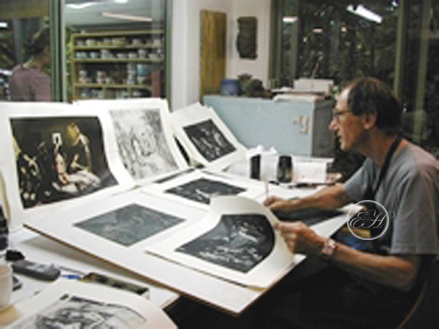
Garry Shead came to visit Etching House again, this time at the 2006 Art Sydney 06 show, he often visits the Art Show showing his support for Art, it is a reflection of his love of art and ours of his. Garry has enjoyed seeing the largest collection of his works in one display from as early as the Stockman series, Bundeena series right to today’s Ern Malley series.
– Garry Shead has recognized that Etching House is focused on generating New collectors to the art world, people who have not yet discovered the joy of collecting fine Australian works of art by prominent Australian artists, for this reason Garry Shead has been keen to keep some of his newly released works very affordable, its a way of giving back to the art world that has been good to him.
– Etching House sets trend and offers to its customers a new 12 month Lay By purchase program (terms and conditions apply) for Australian Fine Art, paintings, Etchings, Works on paper, Limited edition etchings, limited edition prints, prints on paper.
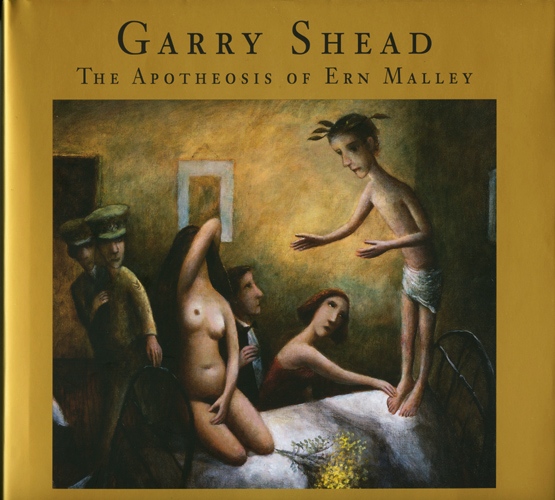
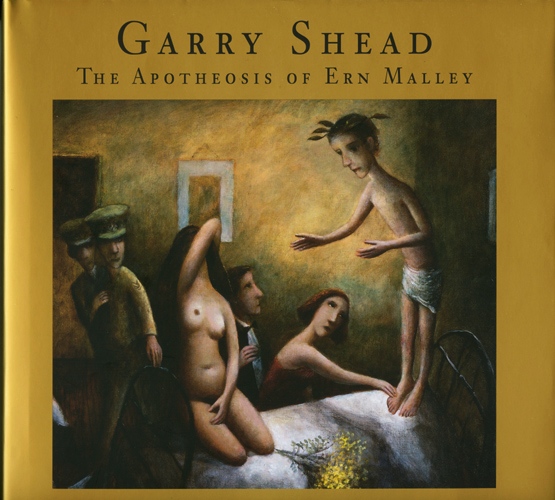
– Garry Shead has completed his new book titled: “The Apotheoses of Ern Malley”
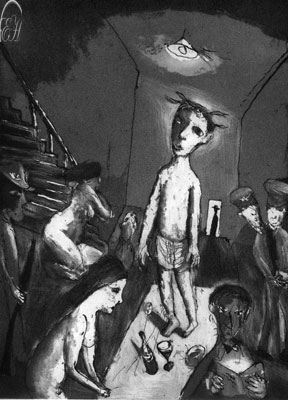
The Book “The Apotheoses of Ern Malley” by Garry Shead contains many images and details from the highly successful Ern Malley series, the book includes three original etchings all signed by Garry Shead, these etchings are:
- “The Immortal Poet”
- “Tragic Poet”
- “The Sleeping Poet”
These new etchings by Garry Shead are loose inside the book to accommodate framing.
– Annunciation Etching, by Garry Shead sold out and rising in value to new high, talk to Etching House.
– Affordable Art Show – Art Melbourne 09, See Garry Shead works April 2009 Melbourne, at Etching House stand.
– D.H Lawrence series – Checkmate – Arrival – Awakening – Thirroul – Wave – all available at Etching House.
– Etching House has the new Garry Shead Tango Dance series In Stock – Original colour Etchings – Tango 1 – Tango 11 – Tango 111. Tango IV March 08, limited stock. .
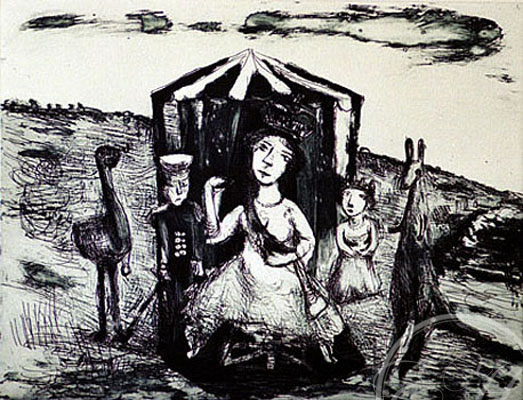
On 5 February 1954, when Garry Shead was just twelve years old, he was taken with other boys from his school to the Sydney Showground to welcome Queen Elizabeth II. Images of the Queen and references to the royal visit start to occur in Garry Shead’s art in the 1960s and come to fruition in a major series of paintings of the mid-1990s. While the ‘Royal Suite’ paintings do engage the republican discourse and many of the images comment on this absurd queen who moves incongruously amongst her subjects, they also comment on feelings of tenderness, on erotic yearnings and on royal fantasies. Dr. Sasha Grishin argues that the ‘Royal Suite’ paintings are icons of their time. They refer to a state of innocence in the 1950s with Blinky Bill koalas and wide-eyed subjects who gather to worship this three-eyed white goddess. They also provide us with glimpses of a reality which we only realized much later, with the Aboriginal people marginalized and exploited, and Australian sovereignty subverted. Perhaps more importantly, they relate to an Australian reality of the 1990s where, by exorcising the daydream fantasies of the past, we can prepare ourselves for independence in the future.
The Queen was Bob Menzies’ white goddess, the white goddess of in the 1950s and the early 1960s. At the base of a lot of opposition to the republic could be a profound filial panic at the idea of losing a female deity.
In 1996 Garry Shead painted a large canvas titled Ceremony. The scene is set against the dusty red earth of inland, with Uluru somewhere on the horizon and a country sports oval in the foreground. On one side a drifting wisp of smoke leads the eye to a camp fire around which several Aborigines are clustered. On the other side, in the background, is a small grandstand accompanied by a few spindly olive-green eucalyptus saplings. The barren outback and endless blue sky contrast with the wonderful green fecundity of the oval, which is enclosed within a neat white picket fence. It is as if a line of demarcation has been drawn separating two worlds that exist independently of one another. On the oval, a slightly ridiculous royal ceremony is taking place. Her Majesty Queen Elizabeth II stands on a stretch of red carpet in full regalia and pours two cups of tea. Presumably one cup is for herself and the other is for her consort. A ceremonial vase containing a sprig of wattle stands on the table before her. Behind the Queen are her subjects, like Magi bearing gifts and accompanied by solemn kangaroos as a guard of honour. To our right, another ceremony appears to be taking place, as Prince Philip kneels on a spread-out Union Jack as if on a picnic blanket. Having stripped off the emblems of office, he seems to be ready to deflower a local bride. These are the strange ingredients that Carry Shead has brought together harmoniously and with great lyrical skill within this glorious sunlit composition.
On first encounter, many elements in this royal iconography (and the numerous variations that pervade the ‘Royal Suite’ series) appear enigmatic, even slightly incongruous, despite the pictorial clarity with which the artist has defined the imagery. While the participants appear at once recognizable through their various attributes and insignia, a single coherent reading is not possible. Rather, there are several competing narratives, both public and private, brought lovingly together under the glare of the all-encompassing Australian sun. And, on closer investigation, identities can prove ambiguous and slightly problematic.
If indeed this is a series of paintings about the youthful Queen Elizabeth II – identified through crown and regalia – then the purpose of her location in the unmistakably Australian setting is not immediately apparent. If the figure next to her is the royal consort, then how do we interpret the strange sexual ceremonies in which he also participates, sometimes to one side or behind a door that has been left ajar? This ambiguity is given a further dimension, for if we glance into Prince Philip’s face we may notice a semblance of the artist’s own features. The queen of the paintings may also be playing more than a single role – while she appears as Queen Elizabeth II, who at the age of twenty-eight first visited Australia in 1954, her facial features resemble a youthful image of the artist’s mother.
The seriousness with which the participants play out their absurd roles, and the singular determination with which they confront their predicament, subverts an easy narrative interpretation. This is not merely a grand spoof. The canvases can be read as history paintings, rich in a sense of allegory; they are also narrative paintings that go beyond simply telling a story. More accurately, they can be described as history paintings involved in telling many stories which are built up in layers of pictorial narrative. They present a palimpsest through which we catch echoes of the royal progress, personal sexual fantasies and daydreams, the republican discourse, and other biographies and autobiographies. Interwoven through this rich fabric are various visual clues; their interpretation has been ultimately left to the viewer.
On 3 February 1954, when Garry Shead was twelve years old, Queen Elizabeth II became the first reigning monarch to visit. During the two months of her national tour, accompanied by Prince Philip, an estimated seventy per cent of the Australian population flocked to see her in person.
Garry’s parents took him on a journey to Mossman where they camped overnight in order to watch the royal liner, Gothic, enter Sydney Harbor. They were amongst the estimated half-a-million people who lined the headlands to welcome Her Majesty. The following morning, when the Queen stepped ashore at Farm Cove at 10.43 a.m., Sydney gave the monarch, in the words of the local press, a ‘gay and boisterous welcome’.
On the first day of the visit, approximately one-and-a-quarter-million people paid homage to the Queen in Sydney. That night a massive fireworks display culminated in a great pyrotechnic portrait of the Queen and Prince Philip.
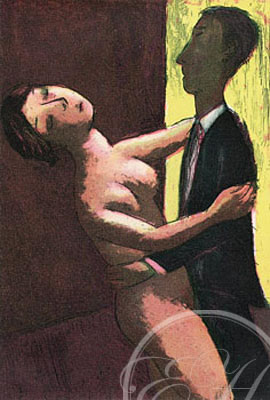
Tango 1 by Garry Shead and about the Etchings and the process of making a multi-plate colour etching.
As used in Tango I, involves the artist drawing parts of the image on each of the three plates. Some information is on a plate which is inked up all over in yellow, some of the marks and tones are red and are drawn on the second plate, while the main or key information (lines and dark tones) is drawn on the key plate and printed last.
Garry first does a loose pen drawing onto the first zinc plate which has on it a very thin emulsion or coating, through which Garry then scratches the line drawing. These lines expose the plate underneath, and then they can be etched in nitric acid to establish them in the plate. The plate is usually proofed (printed) at this stage.
The next stage on the key plate is to put in the tones. Some areas of Tango I are light in tone, whilst others are very dark indeed. A light coat of rosin powder is applied to the plate surface and melted on. Garry paints a resist onto the plate to protect the areas which are to have no black tone. The plate goes into the acid for a short time. Then a further resist is applied to areas which are to remain fairly light. Into the acid goes the plate for a second time. This process is repeated until only the darkest shadows are still exposed to the action of the acid. These areas of the plate are etched for the longest time in acid and are bitten the deepest. Garry is able to study a proof of this tonal state and actually scratch and smooth back areas which he feels are too dark.
The whole image is then transferred to plates #2 and #3 and lightly etched so he can see the outlines. Areas of the yellow plate which are to be yellow in the print are then given an aquatint and etched. Areas of the red plate which are to have red tones on them are also aquatinted and etched. Now the three plates are ready to be proofed together for the first time. They are each fine-tuned by the artist. This stage took place in Wollongong and Darwin for Tango I.
The proofing of the prints takes place once the artist has approved the final proof. Two printers worked together on the printing of Tango I: with the printing of the 75 etchings taking around a week’s work. Some of Garry’s colour etchings take even longer to print, owing to the number of separate plates which need hand-inking for each print.
The techniques described here have been in use for around 500 years. Rembrandt is still regarded as one of the finest etchers to have lived, whilst Goya is renowned for his use of the tonal aquatint process. Garry Shead lives and works in Bundeena, just south of Sydney.
Love on Mount Pleasant
The demolition began early on a winter’s morning in July 1966.
The corrugated iron winery at Mount Pleasant in Pokolbin, that had been the hub of a momentous outpouring of creative genius, was gone. It was the site where the great winemaker Maurice O’Shea, (1897-1956) had spent his working life. Attuned to the natural nuances of every season, he never missed a vintage in his thirty-five years at Mount Pleasant.
It was a time when much of the country’s idiosyncratic heritage was treated with scant regard. Considered an unsafe workplace and an eyesore, the old winery didn’t stand a chance. The respected wine authority, Len Evans, pleaded in vain with the McWilliams family, who had been O’Shea’s sponsor since 1932, to spare this singular piece of Australian wine-making history. Now the only records we have are in anecdotes from the few people who remembered the place, and the photographs taken by Max Dupain of the 1951 vintage wine.
Garry Shead (b.1942) is one who has vivid memories of Mount Pleasant. Maurice O’Shea was Carry’s uncle. His mother, Nora Florence O’Shea, married Gordon Shead in 1937. She was Maurice’s youngest sister. As a child, Shead recalled driving from Sydney’s North Shore to Mount Pleasant during the Easter holidays. The vintage was in, and it was a time to celebrate while the wines matured and slumbered in their darkened casks.
Apart from being the renowned vigneron, Maurice was a superb cook – a true gastronaut, matching wines, perhaps a 1953 Mount Pleasant Florence Riesling (named in honour of Carry’s mother, Nora Florence) or the magical 1937 Mountain ‘A’ Dry Red, with scintillating dishes such as Jewfish poached in white wine, coq au vin or yabbies Provencal, or his rogue dish, Bandicoot in red wine. Close at hand were fresh vegetables from the garden – eggs were never far away and milk was supplied by the cows roaming the paddocks. Maurice’s culinary marvels were fired, baked and steamed in a tiny galley kitchen on a kerosene stove. Of course, he had reinforcements in the form of escapees from the city – the renowned chef, Henri Renault was never far from the action, with further support from the great food and wine entrepreneur, J.K. (Johnny) Walker. This was the culmination of all Maurice’s efforts -bringing together the best of wine and food to enjoy in the company of family and friends.
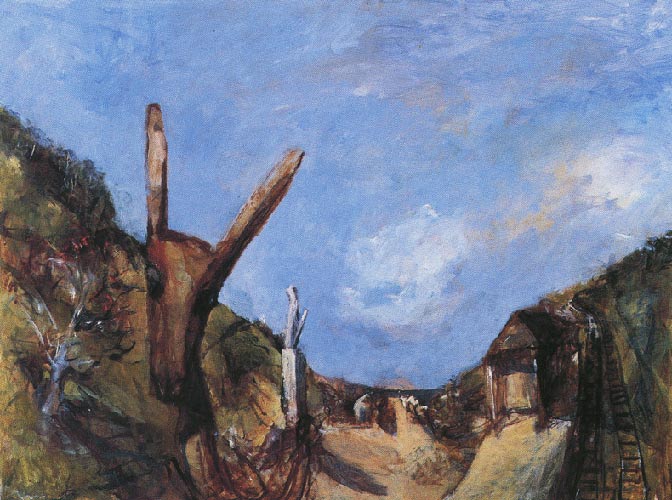
The final act in a day of feasting at Mount Pleasant was a walk up the Old Hill through the gnarled old vines planted by Charles King in 1880. Looking back across the valley, a panorama unfolds linking the bush, the vines, the valley and the sky in an intense landscape experience. The scene was the subject of Garry Shead’s first oil painting View of Mount Pleasant, 1953, where the budding artist seems to have unconsciously obliged the precepts of the colonial picturesque.
From this vantage point, Hal Missingham, then director of the Art Gallery of NSW, observed how Maurice O’Shea’s corrugated iron shed was indeed an integral part of the Australian landscape, and, on closer inspection, imbued with a character unique in its day. The winery encompassed a workplace with its old oak stave presses and concrete vats, cellar, studio and library, living quarters and kitchen galley. There was no electricity – all the work was powered by hand. The corrugated iron structure rose up from a dirt floor, and to keep it cool in summer, the exterior was whitewashed, amplifying the dynamic interplay of light and shade.
In this magical realm, Uncle Maurice supported his nephew’s nascent interest in art. He encouraged the boy, giving him books to fire the imagination -The Little Antoine de Saint-Exupery as well as Shead’s favourite, Captain Marryat’s Midshipman Easy. Maurice was Carry’s earliest mentor. At the time of O’Shea’s death in 1956, Carry Shead, the teenager, was coming to grips with having to wear thick, heavy spectacles to combat myopia, just as his uncle had done to eventually triumph and gain recognition as Australia’s greatest winemaker.
Ten years after Maurice’s death, in the year the winery was demolished, Carry Shead began experimenting with ways of depicting the complex character and nature of O’Shea. In works such as Slightly Bemused, 1966, and Maurice with Bandicoot, 1966, Shead’s witty use of wine-glass bases to represent a pair of spectacles reveals something of the artist’s imaginative process and humorous inclination sparked by the legacy of Uncle Maurice.
Maurice George O’Shea, eldest son of an Irish-born wine and spirit merchant, John Augustus O’Shea, and French-born mother, Leontine Beaucher was born on the 13 June 1897 at 1 Miller Street, North Sydney. Five of six children survived. In May, 1907, Nora was born. She would be Garry’s mother and Maurice’s favourite sibling. Nora was 5 years-old when her father died. The charismatic wine merchant died aged 42 from cirrhosis of the liver. It was said that Maurice inherited his father’s brain and his mother’s heart. Whatever the case, Leontine had to make a decision on the future of her 16-year-old son. The wine business was in his blood. The New South Wales Wine and Spirit Company was the family business. But first, his education would need attending to.
In 1913, Maurice was sent to France to finish his schooling at the Lycee Montpellier. Being bright and charming, he excelled. Having finished school, he was eligible for French military service but, as a consequence of his extreme short-sightedness, he was rejected. For the next two years, he studied at the Ecole Nationale d’Agriculture at Grignon, near Paris. He went on to complete a degree in viticultural science at Montpellier University with qualifications in botany, history and chemistry. It was here he immersed himself in the mystery of fermentation and the creation of wine that begins life with yeasts turning sugar into alcohol. He applied himself to the winemaker’s art, honing his ability to detect subtle fragrances and emerging characteristics that would intensify over time. Briefly, he lectured on analytical wine chemistry, and importantly, travelled the wine regions of France’…tasting the best and worst so that great wine and poor wine and the pathways to both became intrinsic to him.
These encounters, in effect, would be the cornerstone of his future success. At the time, very few talented figures in the arts in Australia had the opportunity to experience first-hand the thrill of recognition that exposure to a first-rate work of art provided. Artists relied on poor reproductions while an aspiring winemaker would have to rely on the safe and gentle passage of vintages from Burgundy and Bordeaux. Etching House specialise in Garry Shead fine art, etchings and prints.
Etching House List of some Garry Shead Oil Paintings, for reference purposes only,
The Arrival, 91.5 x 122.0 cm, oil on composition board, Signed lower left ‘Garry Shead 92’
The Conspirators, 90.8 x 121.5 cm, oil on composition board, Signed lower right ‘Garry Shead 92’
They were there, 91.5×122.0 cm, oil on composition board, Signed lower right ‘Garry Shead 92’
Thirroul, 91.0 x 121.0 cm, oil on composition board, Signed lower right ‘Garry Shead 92’
Railway Station, 91.0 x 121.0 cm, oil on composition board, Signed lower left ‘Garry Shead 93’
Thirroulia, 90.2 x 121.2 cm, oil on composition board, Signed lower left’ Garry Shead 93?
Kangaroo, 91.0 x 121.0 cm, oil on composition board, Signed lower right ‘Garry Shead 92’
The Presence I, 91.5×122.0 cm, oil on composition board, Signed lower right ‘Garry Shead 92’
The Struggle,122.0 x 152.5 cm, oil on composition board, Signed lower right ‘Garry Shead 92’
1922, 122.O x 152.5 cm, oil on composition board, Signed lower left ‘Garry Shead 92’
Fame, 91.5 x 122.0 cm, oil on board, Signed lower right ‘Garry Shead 93’
The Visitors, 91.5 x 122.0 cm, oil on composition board, Signed lower right ‘Garry Shead 92’
The Wave, 91.0 x 121.0 cm, oil on canvas on board, Signed lower left ‘Garry Shead 92’
Le dejeuner sur I’herbe, 91.5 x 122.0 cm, oil on composition board, Signed lower right ‘Garry Shead 92’
Aboriginal, 91.5 x 122.0 cm, oil on composition board, Signed lower left’ Garry Shead 92?
Headland, 91.5 x 122.0 cm, oil on composition board, Signed lower left ‘Garry Shead 92’
Sentinel, 91.5 x 122.0 cm, oil on composition board, Signed lower right ‘Garry Shead 92’
The Cliff, 91.5 x 122.0 cm, oil on composition board, Signed lower left ‘Garry Shead 92’
The Letter, 122.0 x 152.5 cm, oil on composition board Plate 20, The Presence II,
Nightfall, 91.5 x 122.0 cm, oil on composition board, Signed lower right ‘Garry Shead 92’
Nightfall, 62.0 x 60.0 cm, oil on composition board, Signed lower left ‘Garry Shead 92’
Firelight, 122.0 x 152.5 cm, oil on composition board, Signed lower right ‘Garry Shead 92’
The Dream,122.0 x 152.5 cm, oil on composition board, signed lower right ‘Garry Shead 92’
New Land, 90.5 x 121.4 cm, oil on composition board, Signed lower right ‘Garry Shead 92’
The Guards, 91.5 x 122.0 cm, oil on composition board, Signed lower right ‘Garry Shead 92’
The Antipodes, 90.5 x 120.5 cm, oil on composition board, Signed lower right ‘Garry Shead 92’
Rainbow, 60.0 x 60.0 cm, oil on composition board, Signed lower right ‘Garry Shead 92’
The Cocky, 91.5 x 122.0 cm, oil on composition board, Signed lower right’ Garry Shead 92?
Flaming Kangaroo, 91.0 x 121.5 cm, oil on composition board, Signed lower right ‘Garry Shead 92’
Creation, 91.5 x 122.0 cm, oil on composition board, Signed lower right’ Garry Shead 92?
The Dance, 62.0 x 60.0 cm, oil on hard board, Signed lower right ‘Garry Shead 93’
The Awakening, 91.5 x 122.0 cm, oil on hard board, Signed lower right ‘Garry Shead 93’
The Envoy I, 91.5x 122.0 cm, oil on composition board, Signed lower right ‘Garry Shead 92’
Noon, 25.5 x 30.5 cm, oil on composition board, Signed lower right ‘Garry Shead 92’
Treason, 91.5 x 122.0 cm, oil on board, Signed lower right ‘Garry Shead 92’
The Secret, 60.0 x 60.0 cm, oil on composition board, Signed lower right ‘Garry Shead 92’
Intruder, 91.5 x 122.0 cm, oil on canvas, Signed lower right ‘Garry Shead 92’
Marriage, 91.5 x 122.0 cm, oil on board, Signed lower right ‘Garry Shead 93’
Checkmate, 91.0 x 121.5 cm, oil on composition board, Signed lower right ‘Garry Shead 93’
The Supper, 91.0 x 122.5 cm, oil on composition board, Signed lower right ‘Garry Shead 92’
The Meeting, 91.5 x 121.0 cm, oil on composition board
Death of Cooky, 91.0 x 106.0 cm, oil on canvas, signed lower right ‘Garry Shead 92’
Death of Kangaroo, 91.5 x 122.0 cm, oil on composition board, Signed lower right ‘Garry Shead 92’
The Monument, 91.2 x 121.0 cm, oil on composition board, Signed lower right ‘Garry Shead 93’
Main Street, 91.5 x 122.0 cm, oil on composition board, Signed lower right ‘Garry Shead 92’
Apotheosis of D.H. Lawrence, 91.2 x 122.0 cm, oil on composition board, signed lower left ‘Garry Shead 92’
Here is a list of some of Garry Shead artworks, Art Collection List of Original Etching prints and some paintings,
“The Press ” Coloured State Love on Mount Pleasant Series,
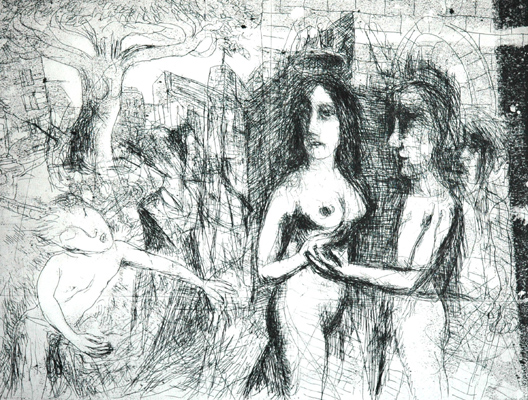
“The Press” Love on Mount Pleasant Etching 24x32cm, edition 50
Annunciation ORIGINAL ETCHING 32.5 x 38 cm
Artist and Muse – Distracted Artist ORIGINAL ETCHING
Artist and Muse – Studio Etching, edition 75, 2 available only
Artist and Muse – Titled Model ORIGINAL SOLD
Baptism of Christ at Bundeena
Black Swan of Trespass Original Etching, edition 50, a few left only
Black Swan of Trespass – Oil Painting 2004, Oil Painting, 92 x 121 cm Not Available
BOOK – Apotheosis Of Ern Malley Inclusive of 3 original etchings. $3300
Book Earn Malley Series The Apotheosis of Ern Malley Book
Checkmate Collagraph, 65 x 90 cm
Coat of Arms ORIGINAL ETCHING edition 50
Coronation ORIGINAL ETCHING edition 50
Darkening Ecliptic Original Etching, Image size 49x69cm
Darkening Ecliptic 2 left Original Etching, Black and White
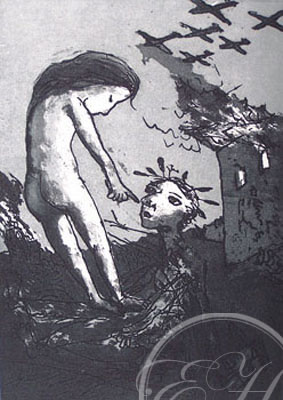
Death of Ern ORIGINAL ETCHING
Deer ORIGINAL ETCHING SOLD
Dionysus at Pokolbin 2010 Etching 24x32cm, edition 50
Epiphany – Oil Painting 2005 Record Price, $219,000 SOLD
Epiphany Etching ORIGINAL ETCHING
Feast at Mount Pleasent Etching – Oil Painting
Flame Etching 20x15cm
Garry Shead at Bundeena 2006
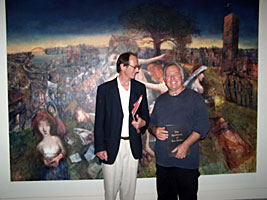
Garry Shead and Rolf Mende At the Art Show
Garry Shead Etching Prints Garry Shead Quality Fine Art Etchings
Gymea Lily ORIGINAL ETCHING SOLD
Horse and Lady ORIGINAL COLOURED ETCHING 2005
Inferno Etching 20x15cm edition 50
Journeys into Australia Peter Sculthorp, Garry Shead DVD $35 PH
Knighthoods ORIGINAL ETCHING
Last Muse Etching 29.5×24.5cm
Monument ORIGINAL ETCHING
Mountain 1937 Maurice O’Shea, Love on Mount Pleasant
Petit Testament II 2004,Oil, 92 x 121 cm SOLD
Petit Testament II ORIGINAL ETCHING $895 only
Queen of Suburbia 2007 Record Auction Price of $432,000 SOLD
Staircase of Flesh ORIGINAL ETCHING $895
Staircase of Flesh Oil on Linen 2005, Private Collection NOT FOR SALE
Stockman’s Dream ORIGINAL Coloured Etching 2006
Tango I ORIGINAL ETCHING
Tango II ORIGINAL ETCHING
Tango III ORIGINAL ETCHING Tago Dance seires
Tango IV Etching 29.5x 24.5cm
Tango Lesson ORIGINAL ETCHING
Tango V Original Etching 19x12cm $990
Tango V Etching Black and White $660
Tango VI Original etching, 19x13cm $990
Tango VII 19x13cm $990 hand signed
Tango VII 19x13cm Black and White Etching
Tango VI $660 Black and White Etching
The Arabian Tree ORIGINAL ETCHING
The Arrival Collagraph, 65 x85 cm
The Arrival Etching
The Awakening Collagraph, 65 x 90 cm NOW
The Bride (Mount Pleasant) 60×90 edition of 55 only
The Dance Oil Painting 121 x 90 cm
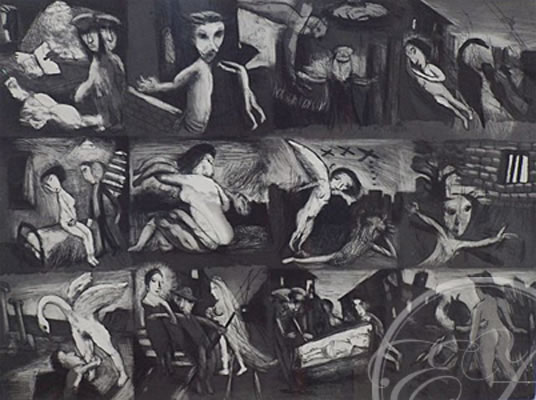
The Death of Ern Malley ORIGINAL ETCHING
The First Vintage Etching image size 24x32cm, edition of 50
The God Game ORIGINAL ETCHING $895
The Horse breaker ORIGINAL Coloured Etching 2005
The Immortal Poet The Apotheosis of Ern Malley
The Letter SOLD $174,000
The Magus Study ORIGINAL ETCHING
The Poets ORIGINAL ETCHING
The Presence ORIGINAL ETCHING
The Resurrection of Ern Malley Etching
The Sacrifice Etching edition 65 only, 65x100cm
The Sculptor Original Etching $950
The Sleeping Poet $1100 each, sold in set only
The Supper Collagraph, 65 x 90 cm
The Wave Collagraph, 65 x 90 cm
Thirroul Collagraph, 65 x 90 cm
Thirroulia Oil 1993 90.2 x 121.2 cm
Tragic Poet 29.5 x 22cm
We Imprison Our Wishes etching
Young Prince – Oil Painting 2004 Record Price $204,000 SOLD
Sentinel Oil on Board Oil on Board 1992
Aboriginal Oil on Board 1992
Checkmate Oil on Composition Board
Creation Oil on Board 1992
Death of Cooley Oil on Canvas 1992
Death of Kangaroo Oil on Composition Board
Dusk Oil on Board 1992
Fame Oil on Board 1993
Firelight Oil on Board 1992
Flaming Kangaroo Oil on Board 1992
Headland Oil on Board 1992
Intruder Oil on Canvas 1992
Kangaroo Oil on Board 1992
Le dejeuner sur l’herbe Oil on Board 1992
Main Street Oil on Board
Marriage Oil on Board
New Land Oil on Board 1992
Nightfall Oil on Board 1992
Nightfall II Oil on Board 1992
Noon Oil on Composition Board
Railway Station Oil on Board 1992
Rainbow Oil on Board 1992
The Antipodes Oil on Board 1992
The Apotheosis of D.H. Lawrence Oil on Composition Board
The Arrival Oil on Board 1992
The Awakening Oil on Hard Board
The Cliff Oil on Board 1992
The Cocky Oil on Board 1992
The Conspirators Oil on Board 1992
The Dance Oil on Board 1993
The Dream Oil on Board 1992
The Envoy 1 Oil on Board 1992
The Guards Oil on Board 1992
The Letter Oil on Board 1992
The Meeting Oil on Composition Board
The Monument Oil on Composition Board
The presence I Oil on Board
The Presence II Oil on Board 1992
The Secret Oil on Composition Board
The Struggle Oil on Board 1992
The Supper Oil on Board
The Visitors Oil on Board 1992
The Wave Oil on Canvas on Board 1992
They were there Oil on Board 1992
Thirroul Oil on Board 1992
Thirroulia Oil on Board 1993
Treason Oil on Board
All images in this site are at the courtesy of the artist.
Garry Shead limited edition fine art prints at Etching House.
An Etching print, or Oil painting are both original works of art, just different mediums.
Garry Shead has started several new etchings from the Mount Pleasant such as, The Bride (Mount Pleasant) being the first of several form the series.
Etching House is a specialist in Garry Shead fine art works on paper, particularly the medium of Etching prints.
Etching House for the largest stock range of Garry Shead etchings prints and works on paper.
Garry Shead, says it is harder to make an etching print than it is to do an oil painting, meditating before commencing any etching or painting work brings out the inspiration to create.
Etching House specialise in Limited Edition fine art Works on Paper by Australian iconic artists, Etching House for over a decade and a half has educated thousands of people in the fine art of collecting Etchings prints and limited edition works on paper, Etching House has been the single largest promoter and educator to the public at art shows fairs of what is and how an etching is made, the etching process is amongst the oldest medium known. Etching prints are a lost tradition that has been around since the 14th century.
Etching House has for years at shows promoted and educated the public as to what the Giclee digital reproduction fine art prints are and explained the process used.
Etching Masters like Norman Lindsay and Lionel Lindsay are two iconic Australian Fine art Etching print makers, Norman Lindsay and Lionel Lindsay have one of the largest body of Etchings works on paper ever made in this country.
Norman Lindsay has over 300 recorded original limited edition fine art etching prints and Garry Shead has been worthy of a similar growing loyal following similar to that of Norman Lindsay an Australian iconic classical artist.
True masters will always be followed, some of the emerging and living iconic artists with a solid following for their etchings prints and fine art works on paper are the likes of – Garry Shead considered to be the best aquatint etcher I have ever seen in Australia, other Australian artists making etchings and works on paper are Jeffrey Smart, Tim Storrier, John Olsen, Margaret Olley AC, AO, David Boyd, Ray Crooke AM, Jason Benjamin, up and coming Jasper Knight, Charles Blackman, up and coming Craig Ruddy, Lin Onus to mention a few.
Etching House say that Limited Edition Works on Paper are well known and respected in the Fine Art World; they are more affordable than original Art works like paintings, Etchings have been hand made since the 14th century.
Garry Shead for Limited edition Fine Art, Etchings, drawings, lithographs, DVD’s Books and Prints at Etching House,
Fine Art, Etchings and Prints by Garry Shead at Weekend Australian Affordable Art Show Sydney, Etching House Stand A10,
Garry Shead Fine Art, Etchings and Prints at Etching House Weekend Australian Affordable Art Show Melbourne,
Garry Shead art in stock at Etching House,
Garry Shead framed and unframed pre owned painting or art works and and limited edition fine art etching prints at Etching House.
Etching House Buy, sell and trade Garry Shead fine art and pre owned paintings and prints, limited edition original etchings, silk-screens, collagraph art work.
Garry Shead fine art comes with certificates of authenticity upon request at Etching House. Garry Shead art is delivered by Woollahra Art Removals upon request.
All images in this site are at the courtesy of the artists.
A complete Garry Shead “DH Lawrence” reference collection is available at Etching House.
Fine art limited edition Australian prints by Garry Shead at Etching House.
Garry Shead new fine art original etching print titled Athena, Maenad and Dionusus at Etching House March 2011, both works are an edition’s of 30 etching prints only, signed Garry Shead lower right.
Australian Garry Shead fine art etching and prints marketed and sold Australia wide by Etching House Fine Art.
Etching House send Garry Shead fine Art Australia wide fully insured and registered person to person with Australia Post.
Australian iconic and up and coming artists Margaret Olley, Garry Shead, Jason Benjamin, Melissa Egan, Kerrie Lester, and Charles Blackman will be at the New South Wales State Library Sydney 12thof May 2011, the event will be have a guest speaker Edmund Capon director of the state gallery of New South Wales who will be welcomed by Richard Neville Mitchell Library.
This event is a celebration in honour of 30 years of service to the art world by Berkeley Editions.
Etching House is proud to be associated with this event and Berkeley Editions.
Australian iconic artists Margaret Olley, Garry Shead, Jason, Benjamin, Melissa Egan, Kerrie Lester, and Charles Blackman attending the 30th year calibration for Berkeley Editions at the state Library of NSW are all Australian artists who also specialise in making fine art limited edition etchings and prints available at Etching House.
Fine Art and etching and print artists Margaret Olley, Garry Shead, Jason, Benjamin, Melissa Egan, Kerrie Lester, and Charles Blackman attending the 30th year calibration for Berkeley, hosted by the State Library Sydney, 12th May 2011, Etching House will be there.
Garry Shead art available at Etching House, Garry Shead art on Lay Buy available at Etching House.
Australian iconic artist Garry Shead fine art collection at Melbourne annual Etching House art fair, See Garry Shead stand A7 Melbourne Art Fair with Etching House.
Garry Shead again wins the crowd at the Etching House Melbourne art fair as the most viewed and popular artist, the show was held at the heritage listed Royal Exhibition Hall next to the Melbourne museum at Carlton Gardens Victoria Australia.
Etching House annual art show held in Melbourne saw the most comprehensive collection of Garry Shead fine art limited edition etching prints on display that spanned Garry Shead’s last 25years, the works on display wowed collectors and viewers from all walks of life with that Garry Shead magical classical etching craft, this etching technique was first started around the 14th century and today is becoming a very rare technique with the advent of the digital age.
Garry Shead is one of the few and one of the very best living Australian artists still using this ancient technique.
On display was fine art works from Garry Shead’s Bundeena, Monarchy series as well as today’s new Mount Pleasant series.
Garry Shead Giclee limited edition fine prints are at this point in time unavailable, Garry Shead original etching, prints, drawings are in stock at Etching House.
Definition of the word Giclee it’s a (noun) – Used as a noun, Giclée refers to a type of art print created by spraying. Indeed, Giclée prints come right out of a computer peripheral that sprays ink. Your standard Desk Jet won’t do. No, we mean a printer that costs a hefty price, and contains many different ink cartridges (at even more expense) that work in unison to produce a high-quality print.
The Melbourne public loved the Garry Shead artworks on paper, people were just spellbound, people were standing there just studying one image at a time, when you see the works in real life you can understand why.
Etching House is proud to exhibit many of these Garry Shead artworks such as limited edition fine art etching prints, lithographic and silkscreen prints, paintings, mostly at annual art shows for over a decade and a half now.